Wednesday, December 30, 2015

Washington Gold Cider Heritage


Success doesn't just breed success or complacency or contempt, it tends also to spawn ersatz markets. Real derivative markets. The economic and popular success of the originals provokes an off-brand market for the knockoffs, popularly priced, crappily constructed imitations made specifically to capitalize on their resemblance to the prototype. Transformers has GoBots. Legos has Mega Bloks. Nick Nolte has Gary Busey. Led Zeppelin has both the Black Keys and the White Stripes. Coke has Pepsi. In Cold Blood has Executioner's Song. Arial has Calibri. The list of first editions and degraded cognates is long and illustrious. And the off-brand editions, they'll do just fine if you have no other option financially or opportunely, or if you're looking for something campy and cheap, but no one is seeking them out if they have access to the exemplars (the original Point Break and Chulahoma aside). Honestly, why would you? They require some sort of exigent circumstances to be pressed into action. They only become viable options out of sheer desperation.

Ciders made from dessert apples are basically the same thing, a secondary market dependent on the primary market. The cider can be okay, even pretty good in some instances (Apple Outlaw does okay with it), but in the end, you know you're not getting the real thing. You're getting an approximation of it. A likeness of it. A suppositious replica with apples pressed into action out of desperation. Washington Gold Cider's Heritage is one such cider. A replica cider made from a wide variety of dessert apples. Supposedly they use everything from Fujis and Galas to Red Deliciouses and Granny Smiths to make their cider, though that information comes from a blog entry and not the cidery's website. Remember back in the day when you would go to 7-11 with your friends and make a suicide by mixing all of the sodas together? In the end, the taste was always anticlimactic and indistinguishable. I guess the same could be said for suiciding apples to make cider. Given all of that variety, you'd think the flavor would be a little more complex or at least interesting but you'd be wrong. You're not left with something deep or rich or interesting in flavor but rather almost the exact opposite. Something boring and unremarkable. Not good or bad. Just... I don't really care.


Didn't someone say that the opposite of love isn't hate but the absence of emotion all together?

Anyway, my first sip tasted a little like a white wine which makes sense because Washington Gold is produced by a winery. After that, it settled down some but still had a bit of the tannic twist of a white. Several reviews I read claimed there was some apple pie to it but I didn't notice much of that. Maybe in a loose sense of the concept of the taste of apple pie, it tastes like apple pie, like calling a frozen pie homemade because you baked it yourself, but it's only a theory. A mere inkling. Apple pie filling maybe but not actual apple pie. Maybe one of those Hostess mini apple pies you can buy off the pastry rack next to the boxes of donuts and Ring Dings at a 24-hour corner store. If anything it tastes a bit like a cherry turnover, or maybe just those canned cherries they use for cheap cherry pies. The bright red kind with the sticky sauce. Toss some yeast into a can of those babies and see what you get. Might not be entirely dissimilar.

The cider has a warming on the throat that increases as I sit with it longer though it seems less like an alcohol warmth and more like a high-acid content burn. Not particularly pleasant unless you enjoy the feeling of something burning a hole in your esophagus. At 5.5% alcohol by volume, it's certainly not potent enough to give you that comforting booze burn. In addition, it's pretty much flat... actually, it's damn near completely flat. There's more effervescence in an open can of Schweppes that's been left out overnight on a park bench. The midwest isn't this flat. It isn't too sweet though, and it is slightly dry and has minimal residual stickiness, so there are some positive attributes to it. And it does look nice in the bottle. It's crystal clear and faintly yellow, like a rumor of yellow. Like if the National Enquireror did a cover story on the color yellow. It's the color of Donald Trump's bangs under cross-examination for shoplifting.

The folks at Washington Gold Ciders have been growing apples on their farm for over 40 years and they have some very nice photos on their website of the family picking apples and playing in the orchards. That being said, there's not much else available about them. No information on what apples they grow or if they supply all of the apples for their own cider. No information on their pressing process or their cider history. Though through careful digging and research, I did discover that the cider is made by Lake Chelan Winery, the winery created by the family farmers when the apple market collapsed back in the late 1990s and they were forced to diversify or die. Perhaps their experience and dedication to wine is why their cider is flat and wine-like. It's more an apple wine than a cider by any standard. 
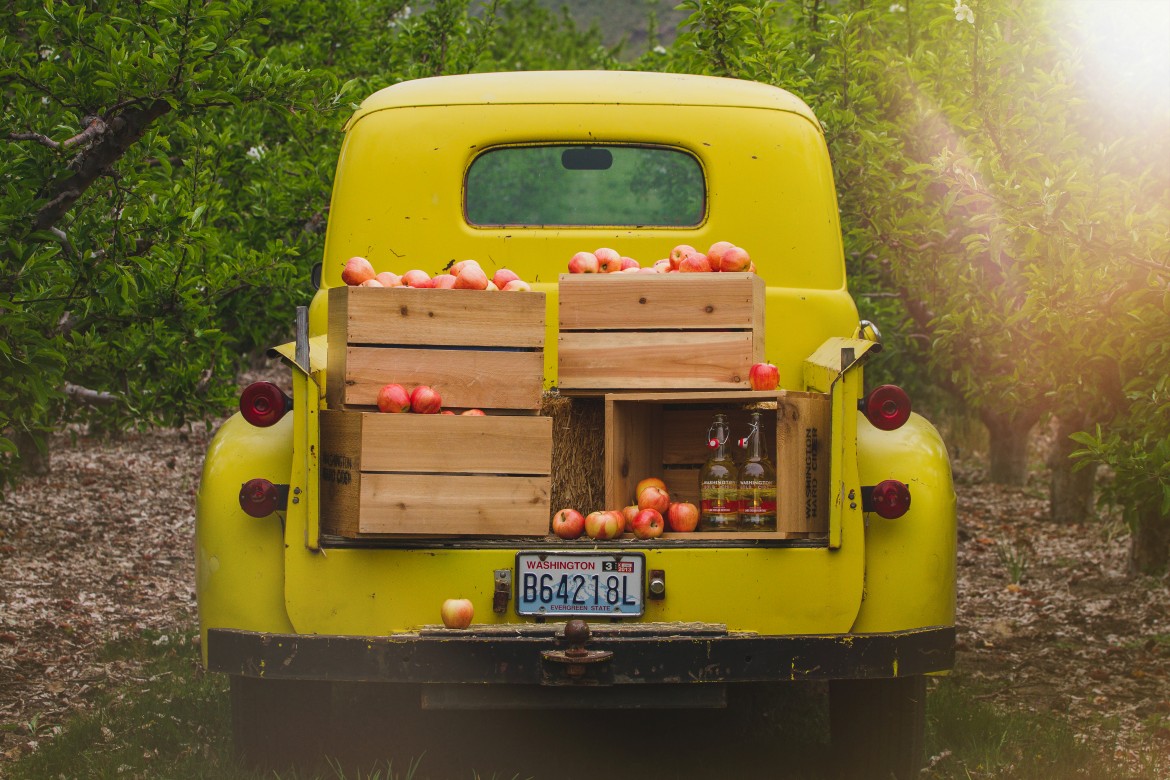

The bottle the cider comes in is heroically large bottle though - too large at 1 pint, 9.4 ounces - with one of those metal-and has one of those hinged stopper caps you get on some growlers. Furthermore, the bottle layout is nice, somewhat elegant in it's simplicity and arty its design but I cannot fathom anyone drinking this much of it at once, thus the stopper. Probably better to bring it to a potluck and drop it off next to the Bugles before anyone sees you.

In the end, I think it's a noble effort though a failing one too. Just not enough here really. From everything I read, it seems like a decent operation run by good people so I feel slightly guilty giving them a poor review. Furthermore, the bottle I drank and used to write this review was a Christmas present so it appears that I am an ingrate - sorry Al. And it's not a bad cider. It's just not a good cider either. Maybe if I was drinking it on ice with some ginger... now that sounds good.

Rating: 

For more information about the cidery visit them at Washington Gold Ciders or at their parent website, Lake Chelan Winery.


Tuesday, August 25, 2015

Angry Orchard Crisp Apple


Just like Dick Cheney was once a baby, Facebook was once just a place for friends, beards were once just beards and the Rolling Stones were once a rock band, Angry Orchard's "cider" was once just innocent apples on the limb. Somewhere along the line something went horribly wrong for these poor little fruits and they found themselves pressed into this saccharine slurry euphemistically identified as "cider". Sure cider and Angry Orchard's Crisp Apple share some characteristics, even some basic ingredients, but calling it cider would be like calling Burger King a restaurant or tank tops clothing.

To be fair, Crisp Apple doesn't taste bad really. It just doesn't taste good either, or at all like cider. It tastes like a slightly tart, lightly molasses-glazed, freshly cut slice of a Braeburn, an apple I have a strong affinity for on its own, but not the flavor I'm looking for. Actually, the "cider" would probably make a nice base for a smoothie. Maybe the folks at Angry Orchard should get in touch with Orange Julius or Jamba Juice. Angry Julius? Seriously though, it tastes just like apple juice. It even looks just like apple juice. I emptied one of my son's juice boxes into the sink this morning and it was pretty much identical in color and aroma, though the juice box had been sitting out all night in the heat so perhaps it had fermented a little, giving it the same vague wine-alcohol tinged scent. It would have been so much easier to learn to drink had Angry Orchard been around when I first started dabbling in alcohol. I mean, the pain, struggles and embarrassment I could've saved myself is immeasurable. Perhaps that connection to youth is what draws people to Angry Orchard. A hearkening back to the days when beer tasted gross, liquor was something hidden in your parents' cabinet and wine was for dinners, weddings and communion. The cloying sweetness reminding people of their glory days, those innocent years that shine lambently in their memories.


Thank you Pints and Panels
There's nothing complex about Crisp Apple. It is a straightforward instrument, almost uncouth in its boringness of flavor - caramelized sugar apple. And the "cider" is almost still. I mean, these are some lazy bubbles. I've seen depressed clowns blow more vigorous bubbles at a bar mitzvah. On the plus side, it's less sticky than I recall or expected. So that's good. I fully prepared myself for a mouthfeel like sipping on a bottle of Karo. Instead, it's relatively clean on the palate, and finishes mildly dryly despite the savage amount of sugar in it - 29 grams - and despite clearly being heavily back-sweetened. And all of that sugar does have the added benefit of providing an early onset hangover, so that's nice. You can start dealing with it almost as soon as you finish your last glass.

I suppose that's what happens when you make a "cider" designed to turn a profit for shareholders as quick as possible. You go sweet and let the consumer sort themselves out after the party's over. It can't just be the apples though that are providing all of the sugar. From everything I've read and all of the research I've done, it seems that Angry Orchard's "cider" maker, David Sipes, is exceptionally evasive when it comes to the actual apples that go into his "ciders". He describes in great detail the places he looks for and purchase apples and what he looks for in apples, however, he doesn't seem to ever actually name a single varietal that he uses. Not in any of the three interviews with him I read or on the Angry Orchard website. Just the regions of Italy, France and the Pacific Northwest that he gets them from. He says they use French bittersweets and Italian culinaries but that's as specific as he gets, even when asked specifically what apples he uses (Beervana interview). To produce the amount of cider that they sell year round, the "cidery" is most certainly using concentrate. The secrecy seems a bit hinky if you ask me. I'm for transparency in all things but fantasy football, poker and bathroom doors. Really, I could understand if they were using some exotic cider apple that was in limited supply or if they were in danger of people ripping the recipe off but seriously, no one is going to do that. The "cider" is just not that good. The impression is that he's trying to hide something. Does he use an apple concentrate from a sketchy third party for his base? Does he not know the varietals he uses? Is it really just a mix of brown sugar and natural flavors mixed to approximate the flavor of an apple?

Angry Orchard started national distribution in 2012 and by 2014 their sales captured 50% of the market, a number that would indicate that Sipes and company are on solid footing and have no need to obscure the details of their product. Their consumers are likely the same people who guzzle Pepsi by the gallon, celebrate birthdays at Buffalo Wild Wings and wipe their sauce-soaked faces on their sleeves. The "cidery", backed by the folks at Samuel Adams (the Boston Beer Company, a company whose stock is traded on the New York Stock Exchange) and their boatloads of cash, is unlikely to see much of its market share diminished by revealing what goes into their "cider". Most people who would care don't drink it anyway. It's not like craft cideries are going to start competing with them for apples or cry foul and accuse them of apple abuse even if maybe they should.

In the end, metal heads would never call Bullet for My Valentine or Five Finger Death Punch metal. The literati would never call the Harry Potter series literature. And no self-respecting cider drinker should call Angry Orchard's Crisp Apple a cider. By most standards, it is not. Too much sugar. Not enough of everything else that makes cider good. Really, it's more of an apple drink. Make the cans and bottles a little louder and you could place it directly next to the tallboys of Four Loko, and six packs of Mike's Hard Lemonade and Zima... Actually, if memory serves, Zimas are a a lot dryer than Angry Orchard.

Anyway, if you are a connoisseur of fine, fast acting and supremely punishing hangovers, you love candied apples but wish they were sweeter, or you are new to drinking alcohol, I highly recommend you run, don't walk, down to the local Circle K and grab yourself a couple cans of Angry Orchard's Crisp Apple. You will not be disappointed.

Rating: 

For more information on Angry Orchard, though not much more, visit them at: http://angryorchard.com/


Thursday, August 13, 2015

Wandering Aengus Wanderlust

Image result for wandering aengusWandering Aengus' Wanderlust is probably my favorite cider right now. Smooth and invigorating in flavor, it is brilliantly quaffable and mostly better than almost every other cider I have had the pleasure and/or displeasure of drinking. I don't know if you can call a cider invigorating with a straight face but I'm doing it anyway. The stuff is enlivening. It has that tonic-like effect on the senses that brings them more sharply into focus. It does, however, have one minor flaw that mars it's otherwise deliciously pristine taste: it isn't spritely enough.

It is my opinion that flaws fall into one of three categories. You have ruinous flaws such as pretty much anyone choosing to invade Russia or Vietnam ever or the repeated gong splashing at the beginning of every goddamn song on James Brown's otherwise brilliant album, "Hell". You have enhancing flaws like inclusions in diamonds or Keanu Reeves' acting in the original "Point Break" and the first of the "Matrix Trilogy". And you have confounding flaws such as how "How I Met Your Mother" was a successful and highly watched TV show without paying off on the title's promise until season fucking nine and the "The Big Lebowski's" bad dub scene. 72 minutes into one of the Coen brothers' five or six top shelf films, there's one of the worst dubs ever. In most movies, you could simply ignore it as an error or the director making due in a pinch, but it's a Coen brothers movie, and they are known for their meticulous attention to detail among a great number of other things. It's a riddle of a flaw. One that demands a purpose. It can't simply be an oversight.

Wanderlust, similarly outstanding, is also possessed of a minor flaw that begs a purpose. A flaw that is a puzzler. It lacks bullish effervescence. It isn't a still cider by any means, in fact it's quite probably of average carbonation, but it doesn't have little nymph bubbles nipping your tongue almost to the point that it makes your eyes water. My preferred level of sparkle. Almost like champagne bubbles. It's a forgivable flaw, if a flaw at all, because the rest of the cider's attributes are so outrageously sublime. And it does fizz up nicely when poured into a glass, providing some light tearing. And it is pale yellow like a Meyer lemon peel thinly shaved and held up against a 60 watt lightbulb, which is nice. I think the tasting wheel would call that, "straw". It's also crystalline as the air on a cold, clear mountain morning at dawn - my glass is fogged up from condensation in the photo - and given to a tart, floral aroma, though nose is far from my strength.

In terms of actual flavor and mouth feel, the cider is lightly fruity, starts sweet, becomes tart, and then dries out nicely at the end, leaving almost no residue behind in it's footprint, but a gentle pinch on the tip of the tongue and the lower, rear pockets of the mouth. Truly, it is one of the most refreshing ciders I've had. Perfect balance of acids, sugars and tannins. Nice complexity of flavor smooth enough for a Rainier-sipping rube to enjoy and deep enough for a wine-sniffing grape sycophant to read into exceedingly and at unnecessary length. It's a classic true cider that would've given George Washington's teeth a taste of home that would've made them long for their mother tree if the myth had been true (alas, his dentures were ivory).

The bottle comes as a true pint, 16.9 fluid ounces, with 6.8% alcohol, and runs a bit pricey at almost $8 each at Market of Choice here in Ashland, though I got a deal on it having arranged to purchase a whole case directly from the cidery in Salem. In fact, I went back a second time this summer and was granted the opportunity to put together a mixed case off their shelves. I chose a little of everything: Bloom, Wickson, Dry Oaked, Wanderlust and Ashmead's Kernel. The cidery is open only for a short window from 4pm to 8pm on Fridays. I happened to be in the area visiting family and getting out of the tinderbox of Southern Oregon, a place where the air currently resembles the smoking room at LaGuardia at sunset in the early 90s.

apple-crate2Wanderlust is made with Oregon-harvested organic Ribston Pippins, a very literary apple having appeared in the writings of Arthur Conan Doyle, Thomas Hardy and Charles Dickens. In addition, the cider-makers use Hudson's Golden Gem, an Oregon native, Calville Blanc, an apple dating to the 17th century and unusually high in vitamin C, Golden Russet, an American variant of an English russet, Winesap and a mix of 12 heirloom apple varieties. Every single ounce of apple in this cider is from organic cider apples. Just good stuff. A quick side note for those of you who are unaware of what russeting is, it refers to the skin which is generally slightly rough, usually with a greenish-brown to yellowish-brown color, kind of like a Bosc pear.

Wandering Aengus takes its name from the William Butler Yeats poem, "The Song of Wandering Aengus", a poem about the endless search for the impossible and unattainable, something perfect and pristine in this world. Perhaps the cider makers of Wandering Aengus envision themselves on such a mission. I certainly hope so, because they are getting quite close with Wanderlust, minor flaw and all.

Rating: 

Learn more about Wandering Aengus at: http://www.wanderingaengus.com/wordpress/

Thursday, July 30, 2015

Apple Outlaw Rabid Dry Cider

In my late teens through my early twenties, that most psychologically vulnerable time in a young man's life, I often found myself wondering at the most inappropriate times, "what would happen if I punched this person square in the face, right now?" It didn't matter who the person was at all. They were almost irrelevant. I could be sitting in a job interview, talking to a professor about an assignment, giving a tourist directions, having dinner with the chief of the village I lived in when I served in the Peace Corps. Whoever. Additionally, it was never accompanied by an actual impulse. Rather, it was more of a curiosity. No malice or intention involved what so ever. Just a simple option my brain presented to my mental decider like it might suggest french fries over onion rings, not leaving my shirt unbuttoned to my navel or how firm a handshake should be. I did often fear that the thought was a symptom of a diseased mind slowly slipping into feverish incivility and outright antisocial mania but everything seems to have panned out okay. So perhaps not. Anyway, in the end, I think it was the same thing that makes me fear heights: the potential to act on impulse. As self-aware beings, really, the only thing keeping us from suddenly smashing the mailman in the face without warning or provocation or jumping off of Table Rock, is the simple decision not to. That little gap between conception and actualization where reason takes ahold of potential and filters it, grabs it by it's collar and smacks some sense into it. Apple Outlaw's Rabid Dry Cider is in that lacuna where potential is an uncarved diamond. It is almost a brilliant cider.

One of the facets of Rabid Dry that makes it so full of potential is the fact that it's a pure cider. There is no added apple juice post-fermentation, an easy route to clearing up any blemishes that might culture during the fermentation process. You can mask your errors with the right back-sweetening like sanding after drywalling or using spellcheck. A pure cider is bold and requires a clear eye. It also means you have to follow the cider closely throughout the fermentation process and keep temperatures steady. The cider makers at Apple Outlaw appear to have that twenty-four carat eyesight and steady hand. One of the most attractive results of a pure cider, when done well, is nice dryness because the yeast has eaten most if not all of the sugars.

When poured into a glass, Rabid Dry is a pale clear golden yellow with a clue of red when held up to the light, like the skin of a Jonagold were it wrapped around a 100 watt lightbulb. I used the sun through my kitchen window. Once in the glass, it has good, almost perfect bubble, nipping the tip of the tongue and tickling the back of the throat gently but pointedly. The cider itself has an outstandingly relaxed, almost imperceptible sweetness with a clean back end. Nice Granny Smith apple tartness with a dry finish. True to it's label, it leaves no residual sweetness. Despite being a conventional 6% ABV, it gently warms the belly with fuzzy, nectar-drunk, late-afternoon butterflies. Indolent and content flutters. It's a brief and nice feeling.

In flavor and aroma, Rabid Dry is a bit straightforward, and for those with complex noses and erudite tastebuds, it might seem a little boring but I prefer my cider tidy. I don't need the hint of must, late-August fig and dried leaves kind of intricacy that flop-wit cider snobs pine for. I don't need a cider experience. It's not a frickin walk through an autumn apple orchard from the 1800s. It should just have bubbles, nice flavor, dry finish and no residual sickly sweetness that clings to the back of your throat. Perhaps that's a bit of a long list to use the word "just", like someone going into a cafe and saying, "I'll just have a blended, double whip, half-caf, cold-pressed, soy, caramel, chai latte with a double shot and a dash of cinnamon and nutmeg. Can you make that decaf? I've got a punch card." None-the-less, that's my kind of cider.

And Rabid Dry is largely my kind of cider. Honestly, it's one of the smoothest, cleanest ciders I have had the pleasure of drinking and it would be great if the cidery would open a taphouse or something so I could taste it fresh from the barrel. I'd happily drive out to the Applegate where they are located to check out their farm and sample their cider direct. I got my bottle for $7 at the Ashland Co-op and I've seen it at other stores around the Rogue Valley for about the same. It's a reasonable price to pay for a finely crafted, organic cider. Even if it's made from dessert apples.

And herein lies my one main issue with Rabid Dry, and also its place of potential. If they could get such solid classic cider taste and overall drinking goodness out of culinary and dessert apples such as Gravenstein, McIntosh and Ginger Gold apples, imagine what they could do with some legitimate cider apples. According to their website, we may just be in for a taste in the future. The orchard at their farm contains over 1,000 trees ranging from Red Delicious and Granny Smith to some unknown heirlooms, but recently, they have added some cider varietals, namely, Wickson and Belle de Boskoop. With those cider apples gradually maturing, Apple Outlaw has a bright future ahead of itself and appear to be pushing on to reach their full potential. And they won't even have to punch their pastor square in the face during communion or throw themselves off of Table Rock to do it. Can I get a hell yeah for consequence-free actualization of potential?!?

Rating: 


Apple Outlaw used to be called Apple Bandit when I first tried it as you can see in the picture at left. No word on the name change though I prefer the old name to the new. It sounds a little more roguish and a little less alliterative; alliteration being made somewhat cliche through over use. No matter. Check out Apple Outlaw's website for more information: http://www.appleoutlaw.com/

P.S. I should probably note that I never acted on the thought or impulse or whatever that I mentioned above. I never blindly clobbered someone, so that's good.


Sunday, July 19, 2015

Four Daughters Winery Loon Juice

The opening sequence of "Penguins of Madagascar: The Movie" features an impressively improbable rescue mission for a wayward penguin egg executed by three of the four Penguins from the richly cast and moderately entertaining "Madagascar" trilogy. The penguins chase the egg down a hill, over the edge of a cliff and finally, onto the deck of an abandoned oil tanker where they manage to save it from the hungry jaws of a trio of leopard seals, launching themselves from the deck by way of a mounted harpoon gun. Riveting stuff to be sure, though there's work to be done in terms of sheer adrenaline-pumping danger and pyrotechnics if DreamWorks wants to join the ranks of the Bond movies or the "Mission Impossible" series. Despite the improbability of the scene, and really, the whole movie in general, it's a nice opening hook. Similarly, Four Daughters Winery's first foray into cider making, Loon Juice, has some nice highlights, especially on the front end. It starts out a bit honey sweet, becomes enjoyably tart, like a crabapple cider, and has a slightly bitter, dry-ish finish that settles out viscid. While a granny smith has a cold, clean, existential tartness, a crabapple's sourness is warmer, softer, fuller, stickier. It doesn't pinch and twist your cheek, and quickly disappear.

The cider is lightly gold, like wheat in late August on the heels of a hot summer or straw left out under the sun too long, and has a vague sparkle that exists briefly at first taste but fades rapidly and is replaced by a sticky mouth feel that gums up the rear roof of you mouth and back of your tongue like a forced apology or a mouthful of Jolly Ranchers. Like those penguins, who reached their peak with their sublime performance in the second "Madagascar" movie, Loon Juice is at its best early on when fresh and cold, before it has coated the back of your throat.

To be fair and honest, a friend brought me this cider all the way from Minnesota and there's no telling what kind of harrowing traveling experience it had rolling around the trunk of his car all of these almost 2,000 summer miles in intermittent air conditioning and wild temperature fluctuations. I do know that there was a camping excursion into 102 degree heat in Madras on the way home, so that might have altered some of the cider's qualities and properties. I mean, pasteurization and an aluminum can can only protect so much.

Even after all of that, on taste alone, it would be hard to tell that Loon Juice isn't made with at least some cider apples. It's the dessert-apple cider closest to a true cider that I've tasted, largely because of that tartness, and possibly because it is a single-varietal cider made with only honeycrisp apples, an apple developed at the University of Minnesota to be sweet, firm, tart, and thus, ideal for eating. Evidently, it's cells are abnormally large and rupture when bitten, thus filling the mouth with juice like Gushers. Furthermore, Four Daughters presses the locally grown apples themselves unlike most commercial operations where apple juice concentrate, frequently made in China and high in sugar, is the base of choice. The apples they use are grown about 25 miles outside of Spring Valley, Minnesota where the winery is located, in the deep south of the state and the resulting cider has a mere seven grams of sugar per serving while sitting at 6% alcohol - they reduce the alcohol by back-sweetening down from 8%.

Four Daughters appears to have gotten into cider on a bit of a whim around a year ago when their head winemaker started recognizing some shared properties between winemaking and cider pressing. Similar to his philosophy on winemaking, he sought to minimize the ingredient list and stay true to the fruit. An honorable goal and pretty successfully executed though it would've been nice if they could've tracked down some cider apples. Perhaps there aren't any available in Minnesota where they are based, though with an 11,000 square foot cidery being built on the property, they might want to start looking for some cider apple farmers or plant some of their own.

In the end, much like the penguins of "Madagascar", this cider is good but best enjoyed in a supporting role, perhaps even just a cameo appearance.


Rating: 


For more information on Four Daughters Winery you can visit the website, though it has nothing on Loon Juice: http://www.fourdaughtersvineyard.com/

Follow Loon Juice on Twitter: https://twitter.com/loonjuicecider